EN
EN

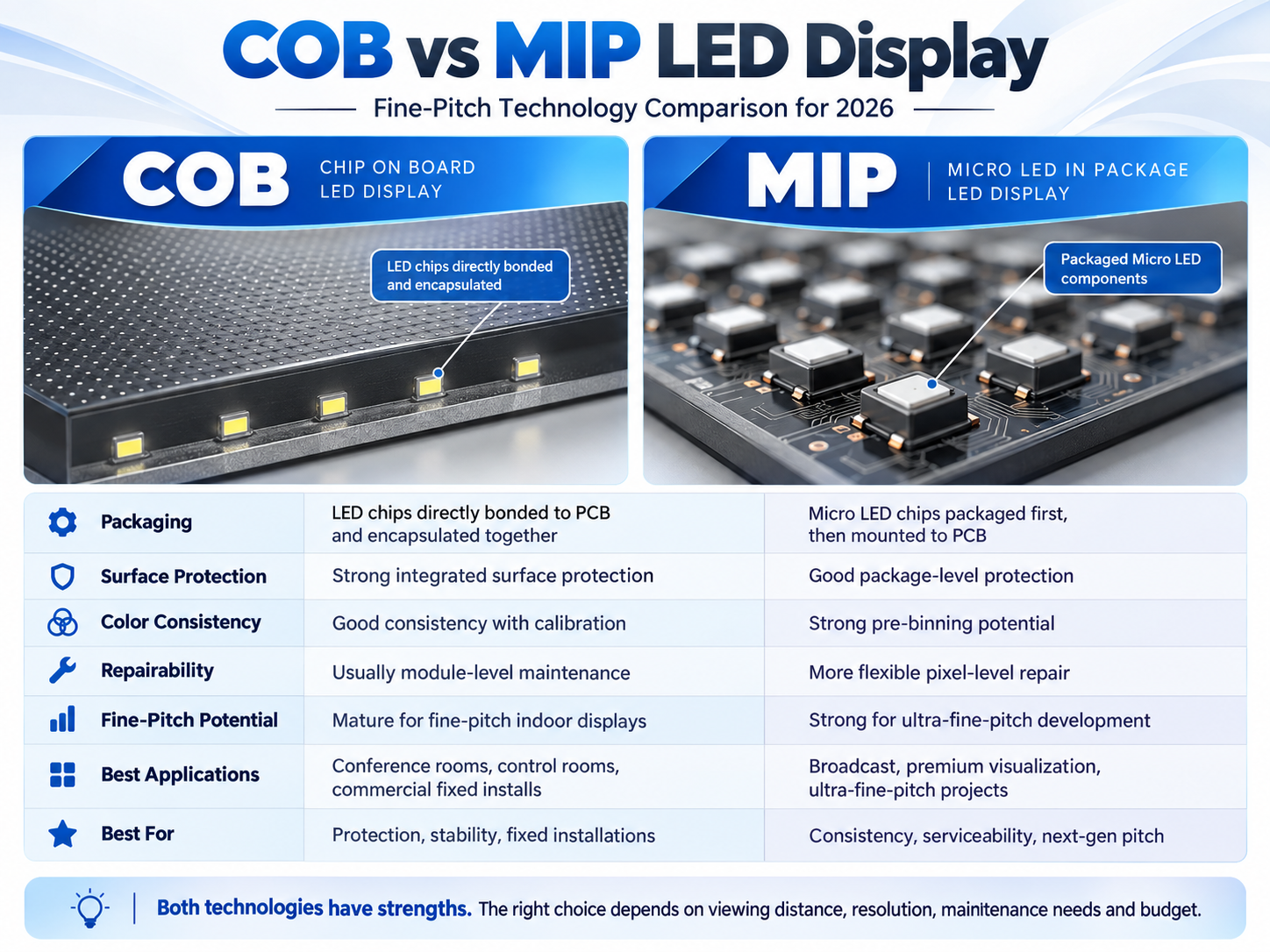
Fine-pitch LED display projects are moving into smaller pixel pitches, closer viewing distances and more demanding visual environments. In 2026, COB and MIP are two of the most discussed packaging routes for indoor fine-pitch LED screens. Both can support high-resolution applications, but they achieve that result in different ways. For buyers, integrators and project contractors, the key question is not simply which technology is newer. The more useful question is which one better matches the installation environment, maintenance strategy, image-quality requirements and long-term operating plan.
COB, or Chip on Board, mounts bare LED chips directly onto the PCB and then encapsulates the display surface as an integrated structure. Because there are no separate exposed LED packages on the front, the surface is smooth and well protected. This structure is widely used in fine-pitch indoor LED displays where close viewing, high contrast and physical durability are important.
MIP, commonly described as Micro LED in Package, first packages very small LED chips into miniature components. These packages can be tested and sorted before they are mounted onto the PCB. The approach retains a discrete package structure while pushing package size much smaller, which makes MIP attractive for ultra-fine-pitch development and for projects where pixel-level consistency and serviceability are priorities
|
Factor |
COB |
MIP |
|
Packaging |
LED chips bonded directly to PCB and encapsulated together |
Micro LED chips packaged first, then mounted to PCB |
|
Surface Protection |
Strong integrated protection and smooth front surface |
Good protection at the individual package level |
|
Color Consistency |
Relies on chip selection plus module calibration |
Strong pre-binning potential before assembly |
|
Repairability |
Often handled at module level |
Can offer more flexible pixel-level repair workflows |
|
Fine-Pitch Potential |
Well established for fine-pitch indoor applications |
Strong potential for ultra-fine-pitch and Micro LED scaling |
|
Best Fit |
Fixed installations prioritizing protection and stable operation |
Projects prioritizing consistency, serviceability and next-generation pitch |
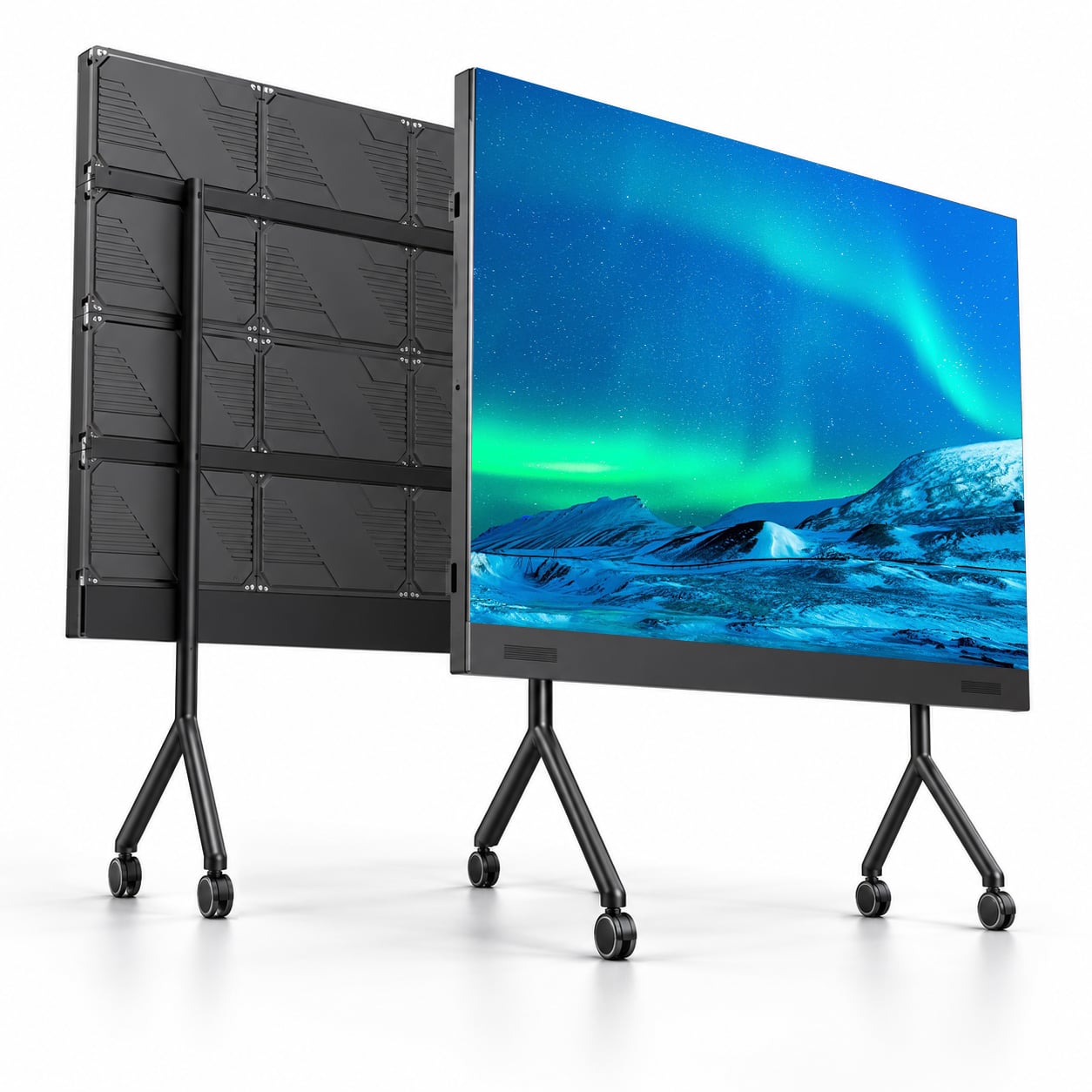
COB is especially strong when the display will be installed permanently and used at close range. The continuous encapsulated surface helps protect the LED chips from accidental contact, dust and moisture, while also creating a flatter appearance. This makes COB a practical choice for corporate boardrooms, command centers, control rooms, premium retail spaces, museums and all-in-one LED displays.
For project owners, another advantage is maturity. COB has already been adopted across many commercial fine-pitch product lines, so integrators can compare established cabinet formats, control systems and application references. Where long-term stability and surface protection matter more than individual pixel replacement, COB remains a strong option.
MIP approaches the problem from a different direction. Because the tiny LED packages can be tested and binned before they are assembled onto the module, manufacturers can control brightness and color consistency at a very small component level. That is useful as pixel pitches continue to shrink and visual uniformity becomes harder to maintain.
MIP can also offer a more flexible repair path because the display is built from discrete packages rather than one fully encapsulated board surface. For projects where serviceability, very high pixel density or future Micro LED scalability are major concerns, MIP can be attractive. Broadcast, virtual production, premium visualization and ultra-fine-pitch installations are common areas where buyers may evaluate MIP alongside COB.
Conference rooms and boardrooms: COB is usually a strong fit because close viewing, durability and a clean surface are important.
Control rooms and 24/7 fixed installations: COB is often preferred when reliability and protected modules are priorities.
Broadcast and high-end camera-facing environments: Both can work; MIP may be considered when consistency and serviceability are especially important.
Ultra-fine-pitch projects below P1.0: Both technologies are relevant. The decision should be based on full-system performance, not the packaging name alone.
Projects with frequent maintenance access: MIP may offer advantages where pixel-level repair strategy is a key purchasing factor.
Do not select a fine-pitch LED display based only on the packaging label. Ask the supplier to provide a complete specification for the actual product series. Pixel pitch, brightness, refresh rate, grayscale performance, contrast, cabinet design, calibration method, power consumption, maintenance method and control system all affect the final result.
It is also important to compare the project as a complete system. A display with excellent packaging technology can still perform poorly if the cabinet alignment, calibration, processing or installation is weak. For B2B buyers, total cost of ownership should include installation, spare modules, repair procedure and expected maintenance over the life of the screen.
There is no universal winner. COB is a proven route for protected, high-contrast fine-pitch displays and is especially suitable for stable fixed installations. MIP offers a compelling path for tighter pitches, precise component sorting and more flexible serviceability. As the fine-pitch LED market develops, the two technologies are likely to coexist rather than one immediately replacing the other.
For a real project, the best choice should start with viewing distance, required resolution, operating hours, maintenance conditions and budget. Colorart can evaluate these requirements and recommend the appropriate fine-pitch LED display configuration for conference rooms, control rooms, commercial spaces and other professional indoor applications.
Not automatically. MIP can offer advantages in component binning and repairability, while COB is strong in surface protection, contrast and mature fixed-installation applications.
Yes. COB is widely used for sub-1mm and other fine-pitch indoor displays. The final choice should still be based on the product’s actual image quality, thermal design, calibration and maintenance strategy.
COB bonds LED chips directly to the PCB and encapsulates them as a complete surface. MIP packages the small LED chips first and then mounts those packages onto the PCB.
 Hot News
2026-10-07
2026-08-07
2026-06-29
2026-06-10
2026-05-11
2026-05-06
Caiyi LED Display Technology is a leading enterprise specializing in LED screens,driving Industry innovation with our patent mechanical led screen







305, Building 18, Advanced Energy Storage and Energy Saving Creative Demonstration Industrial Park, No. 169, Section 2, East Renmin Road, Changsha Economic and Technological Development Zone
Copyright © Caiyi Led Display Technology Co., Ltd. All Rights Reserved Privacy Policy Blog